Guide
How to Involve Kids in Meal Planning: Age-by-Age Guide (2026)
By Editorial Team · Updated 2026-03-29
Getting kids involved in meal planning transforms family dinners from a daily battle into a collaborative routine. Children who help choose, shop for, and prepare meals eat a wider variety of foods, develop lifelong cooking skills, and experience significantly less mealtime resistance. This evidence-based guide breaks down exactly what kids can do at every age — from toddlers picking between two vegetables to teenagers planning and cooking entire family dinners — so you can build a system that works for your household right now.
Affiliate disclosure: This article contains affiliate links. If you purchase through these links, we may earn a small commission at no additional cost to you. We only recommend products we genuinely believe in.
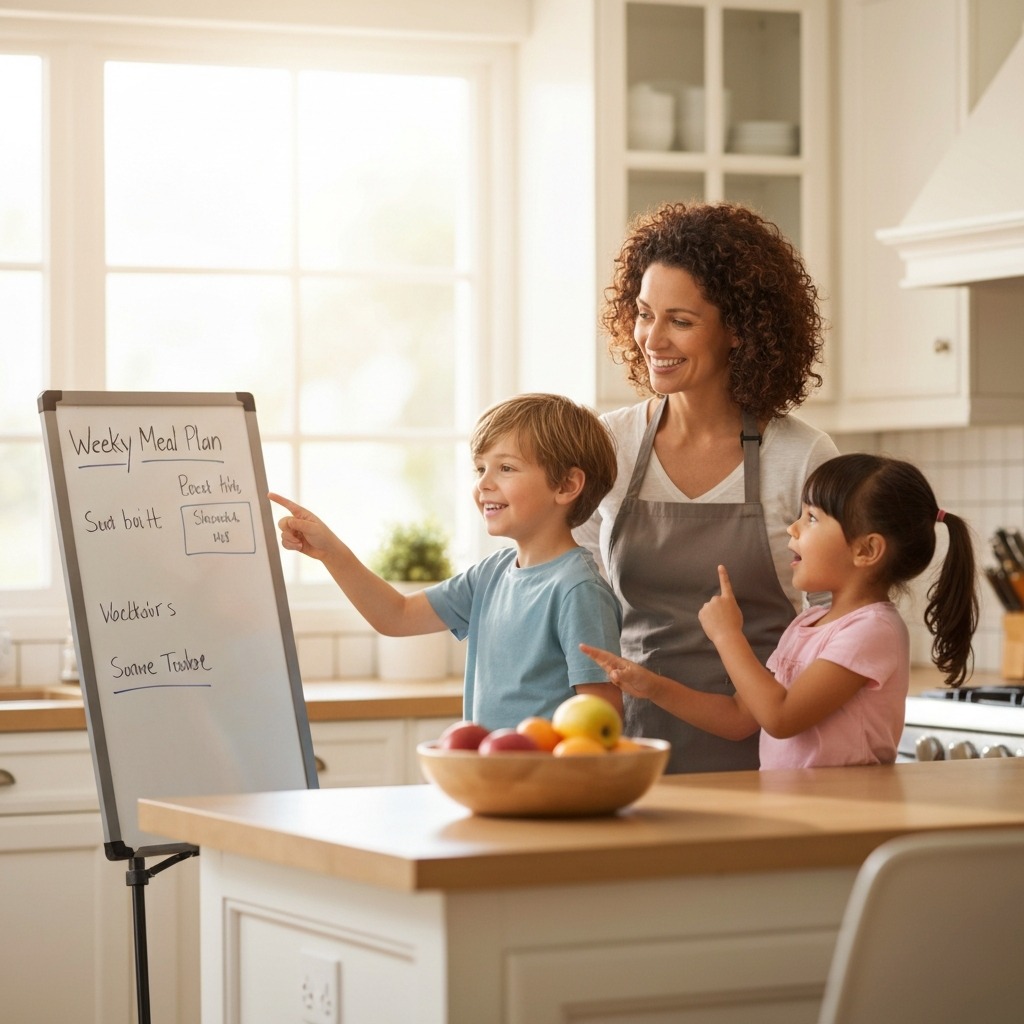 Children who co-create the family meal plan become participants in mealtimes, not reluctant eaters.
Table of Contents
- Why Involving Kids in Meal Planning Works
- Age-by-Age Guide to Meal Planning Tasks
- How to Handle Picky Eaters Through Meal Planning
- Grocery Shopping with Kids: Making It Productive
- Best Meal Planning Tools and Kids Cooking Gear (2026)
- Setting Up a Family Meal Planning System
- Teaching Kids Life Skills Through Food
- Common Mistakes to Avoid
- Frequently Asked Questions
- Sources
Why Involving Kids in Meal Planning Works
The science behind kid-involved meal planning is straightforward: autonomy reduces resistance. When children participate in food decisions, the meal stops being something imposed on them and becomes something they helped create.
Research published in the Journal of the Academy of Nutrition and Dietetics found that children who regularly participated in meal preparation consumed more fruits and vegetables than their non-participating peers. A separate study in Appetite showed that children who helped select ingredients were 2–3 times more likely to try unfamiliar foods.
The Psychology of Food Ownership
Three mechanisms drive the results:
Familiarity effect. Children who washed the broccoli, broke it into florets, and watched it roast have already engaged with it before tasting. The unfamiliar becomes familiar through touch, smell, and involvement.
Autonomy and buy-in. Child development research consistently shows that perceived control over choices reduces oppositional behavior. A child who picked Tuesday's dinner doesn't fight Tuesday's dinner.
Competence building. Each successful kitchen task — measuring flour, cracking an egg, following a recipe — builds the child's confidence. Confident kids are more willing to experiment with food.
If you're new to structured meal planning, our complete guide to meal planning in under 30 minutes covers the foundational system that makes kid involvement practical.
Age-by-Age Guide to Meal Planning Tasks
The most important principle across every age group: structured choice, not open-ended freedom. Asking "what do you want for dinner?" produces either decision paralysis or a list of chicken nuggets. Instead, offer curated options within boundaries you've already set.
Ages 2–4: Simple Choices and Sensory Play
Toddlers can't plan a meal, but they can make a choice and feel its impact — "we're having this because I picked it."
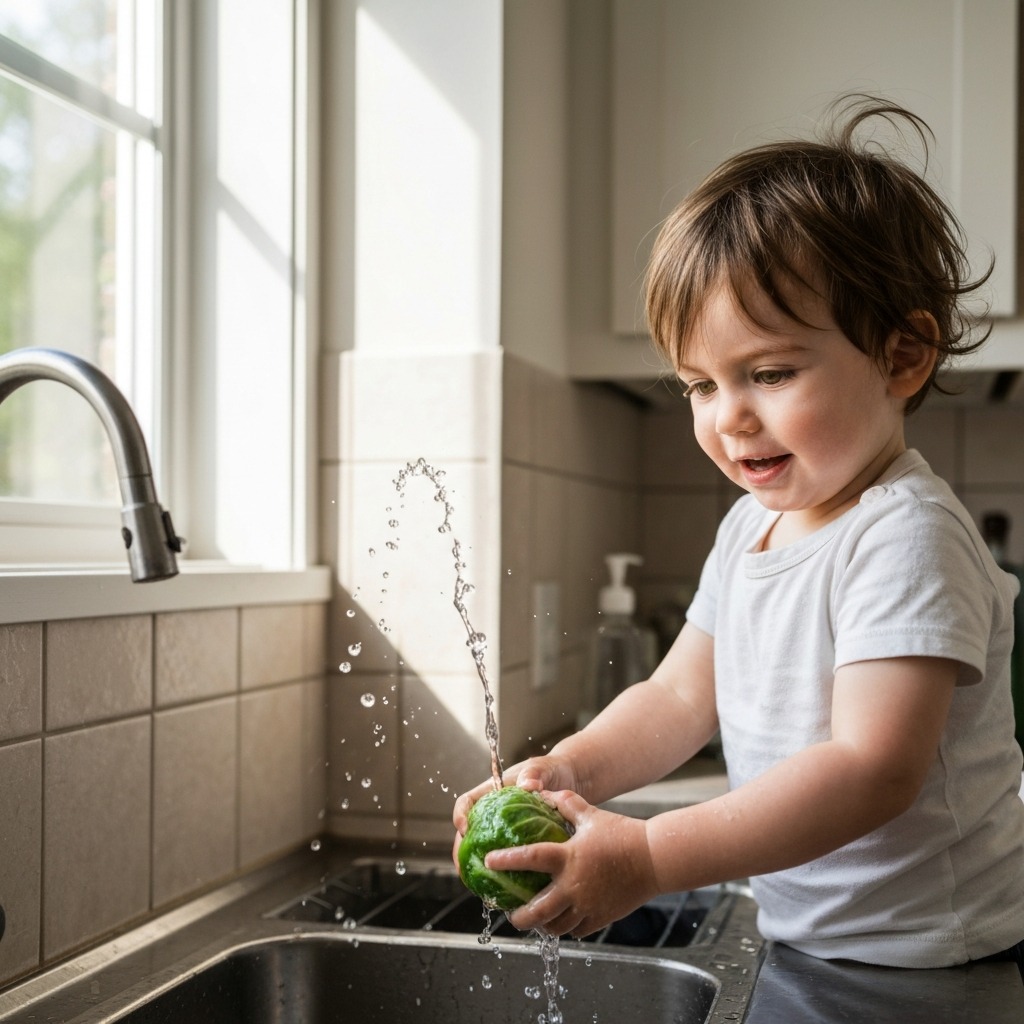 Even toddlers can participate — washing vegetables is safe, sensory, and builds early food connection.
What Works at This Age
Binary food choices. "Do you want peas or corn with dinner?" Not "what vegetable do you want?" — they can't process open-ended food categories yet. Two concrete options, one choice.
Grocery store picking. Let them select one item within a category. "Pick any apple" or "choose which colour pepper." The item they physically touched and carried is the one they'll show interest in eating later.
Washing and rinsing. Toddlers can wash vegetables and fruit under running water. It's hands-on, sensory, and gives them a genuine role in the kitchen workflow.
Simple assembly. Bread, a nut butter, and a child-safe spreading tool — they made lunch. The pride a two-year-old feels from making their own sandwich is enormous and worth the mess.
Realistic Expectations
Don't expect them to eat everything they chose. Involvement at this age builds the habit and the relationship with food, not guaranteed consumption outcomes. Consistency over weeks and months is what produces results.
Ages 4–6: Recipe Helpers and Grocery Explorers
Children at this age are capable of meaningful kitchen contributions and are forming genuine food opinions they can articulate.
 Children aged 4–6 can handle measuring, stirring, and assembling — building real kitchen confidence.
Meal Planning Involvement
The "pick one" system. Each week, this child picks one dinner from an approved list. It goes on the meal plan. They know it's coming. The anticipation itself is valuable — they've been looking forward to "their" dinner all week.
Picture recipe books. Simple, illustrated cookbooks for children give them ownership of the idea. "I found this in my cookbook" is a powerful motivator for trying new things.
Shopping list contributions. Give them a picture-based list of 3–4 items to find during the grocery trip. They locate and select the items. They feel like genuine contributors to the family operation.
Safe Kitchen Tasks (Ages 4–6)
- Measuring dry ingredients with cups and spoons
- Peeling bananas and mandarin segments
- Stirring batters, sauces, and cold mixtures
- Tearing salad greens and herbs
- Decorating food (cheese on pizza, berries on porridge, sauce drizzling)
- Kneading dough with supervision
Ages 6–9: Junior Menu Planners
School-age children can engage with meal planning in a structured, meaningful way. This is the age where a physical or digital meal planning system starts paying dividends.
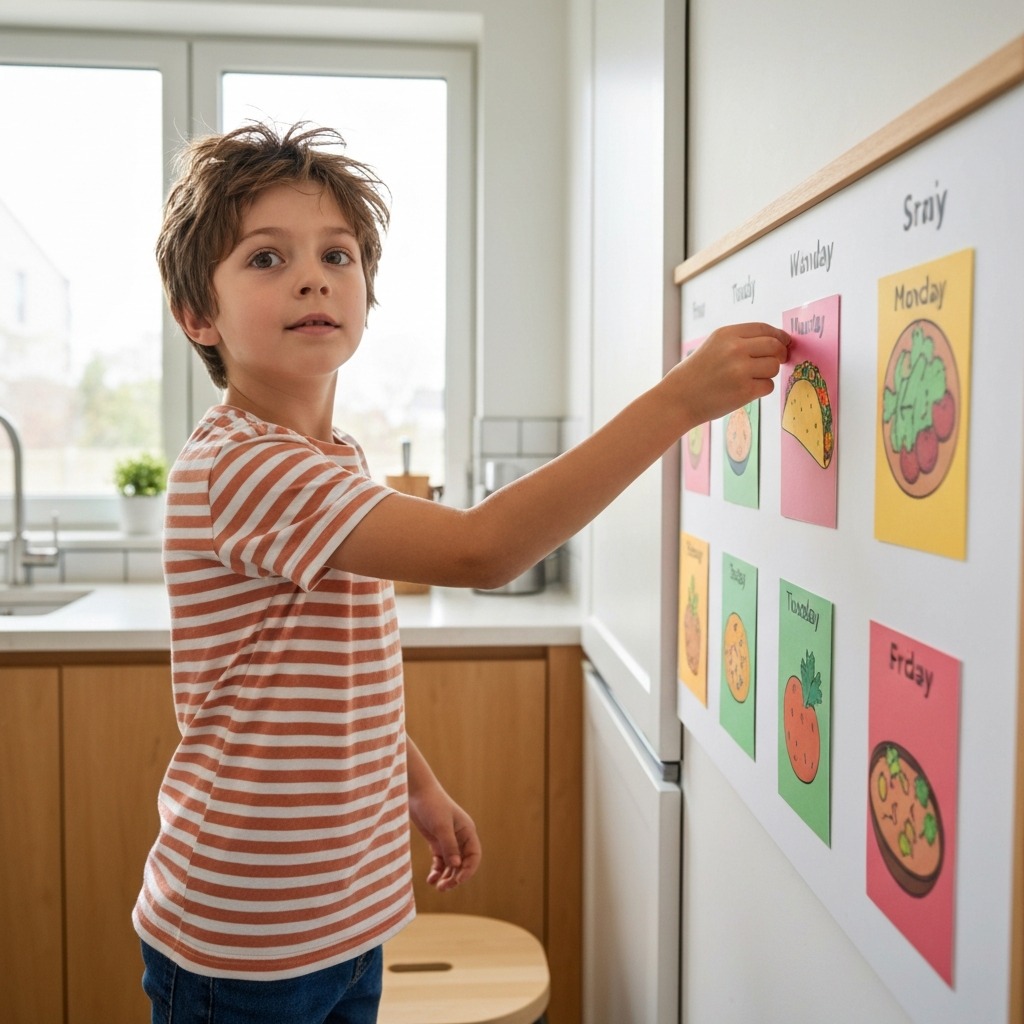 A visual meal planning board makes children's choices tangible and builds genuine investment.
The Weekly Meal Board
Set up a family meal planning board — physical or digital. Each week, your child fills in 2–3 dinner slots from an approved list or from options you offer.
Physical version. A whiteboard or corkboard in the kitchen with day labels. Meal cards or sticky notes that children physically place. The tactile element matters — moving a card from the "options" pile to "Wednesday" feels real.
Digital version. A shared family calendar or a simple meal planning app where they can add their picks. Kids this age are increasingly comfortable with digital tools.
This age group loves seeing "Monday: Emma's taco night" on the board. The connection between their decision and the real dinner is deeply satisfying.
Introducing Basic Meal Balance
Start gentle conversations about meal components: "We need a protein, something colourful, and a grain." This isn't a lecture — it's scaffolding. "If you're picking pasta, what should we have alongside it?"
Children at 6–9 can often engage with the logic of balance without it feeling prescriptive. "You're right, we do need something green with that" becomes natural.
Safe Kitchen Tasks (Ages 6–9)
- Peeling vegetables with a Y-peeler (with supervision)
- Cracking eggs
- Grating cheese with a box grater
- Reading simple recipes and following steps
- Using a toaster and microwave independently
- Washing dishes and loading the dishwasher
Ages 9–12: Co-Creators in the Kitchen
This is the most valuable age range for building genuine food capability and planning ownership.
 Children aged 9–12 can co-plan the week's meals with a real understanding of household constraints.
Genuine Co-Planning
Children 9–12 can legitimately co-plan the week's meals while understanding constraints: budget, nutrition, available cooking time, and the family's different preferences.
Weekly planning session. Set aside 15 minutes on Sunday. Sit together, check the fridge and pantry, and plan the week as a conversation. "We've got chicken, there's rice left over, Dad needs something quick on Tuesday — what do you think?"
Budget awareness. Introduce simple budget concepts. "We usually spend about $40 on weeknight dinners. If we make pasta twice, we can afford salmon once. What's your preference?" This builds financial literacy alongside food skills.
Recipe research. Children this age can browse recipe websites or cookbooks to find new ideas. Give them a quota: "Bring me two dinner suggestions for next week." This develops initiative and research skills.
Kitchen Independence
- Safe knife skills with an appropriate knife (supervised)
- Following multi-step recipes independently
- Making complete simple meals: scrambled eggs, pasta dishes, salads, sandwiches
- Basic food safety: handwashing, temperature awareness, cross-contamination prevention
- Operating the oven and stovetop with adult awareness
Our batch cooking guide for families pairs well with this age group — kids 9+ can handle weekend meal prep tasks like making base sauces or prepping vegetables for the week.
Ages 12–14+: Teen Meal Ownership
Teenagers are capable of owning complete meal cycles — planning, shopping, cooking, and serving.
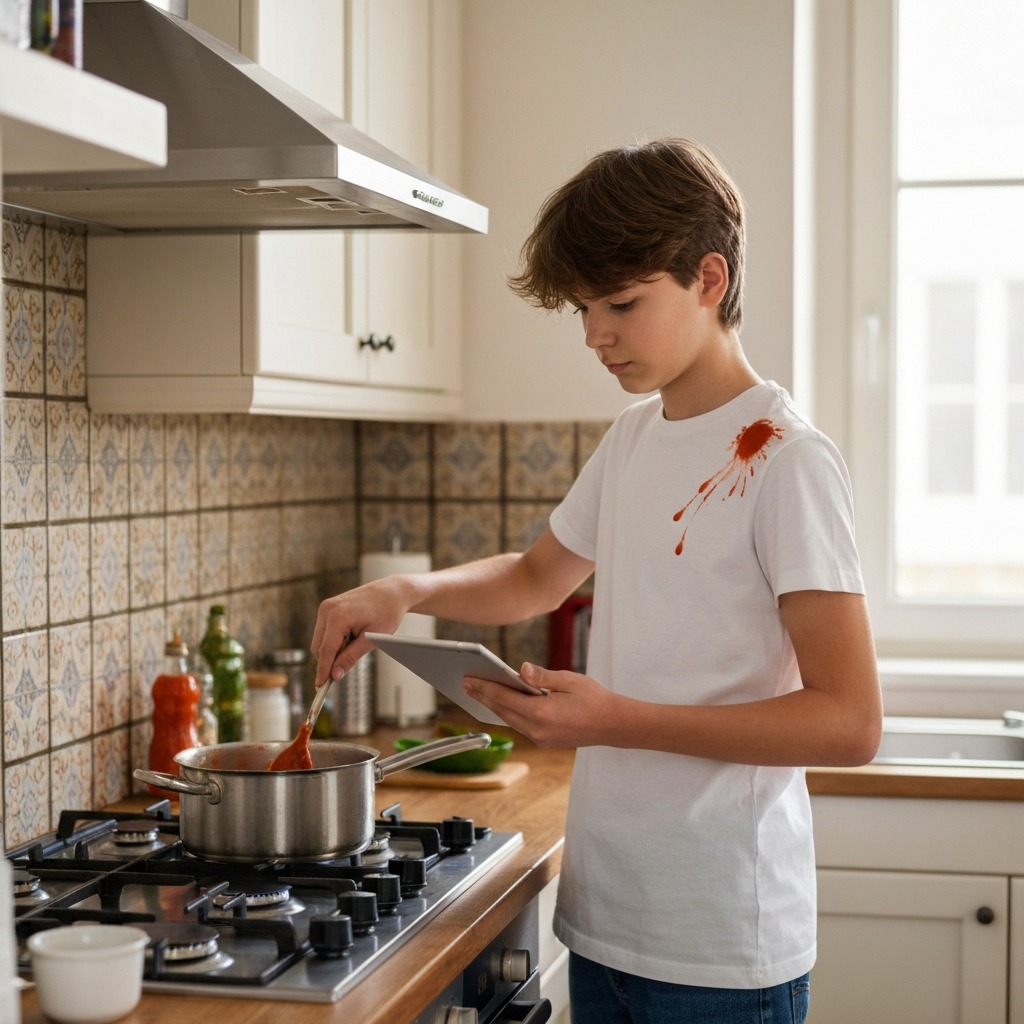 Teens given real cooking ownership develop confidence and practical skills that last a lifetime.
Rotating Cooking Nights
Assign each teenager one dinner per week where they're fully responsible: they plan it, contribute to the shopping list, and cook it. Constraints are appropriate — budget, nutrition balance, timing — but the ownership is real.
The pride a 13-year-old feels after cooking a successful family dinner is formative. This is teaching kids life skills at home in the most practical way possible — through hands-on experience that produces a tangible result the whole family shares.
Batch Cooking and Advanced Skills
Interested teens can participate in weekend meal prep: making base sauces, cooking grains in bulk, prepping vegetables for the week, and assembling freezer meals. This teaches time management, forward planning, and the practical competencies they'll need when living independently.
Teen-Specific Strategies
- Let them experiment with cuisines that interest them (Korean, Mexican, Italian)
- Encourage them to cook for friends — social motivation is powerful at this age
- Connect cooking skills to their interests: fitness-focused teens can learn about macronutrient balance; creative teens can explore food presentation
- Give genuine feedback, not just praise — teens can tell when you're being patronizing
How to Handle Picky Eaters Through Meal Planning
Picky eating is one of the most common reasons parents try meal planning involvement — and it works, but requires patience and realistic expectations.
Evidence-Based Strategies
Pair new foods with familiar ones. Never replace a comfort food entirely with something new. An unfamiliar ingredient alongside a loved one on the same plate reduces the perceived threat.
Involve the picky eater in preparing the specific food they're nervous about. Sensory exposure — touching, smelling, watching it cook — significantly reduces the novelty fear response. A child who helped make the stir-fry is more likely to taste the stir-fry.
Celebrate trying, not finishing. "You tried it, that's great" matters more than "you only had two bites." Progress comes from repeated low-pressure exposure over weeks and months — not from forced consumption at a single meal.
Let the child be the expert on their experience. Ask: "What does that taste like to you?" and "What would make it better?" This invites engagement and curiosity rather than compliance and judgment.
Use the "no thank you" bite rule. One bite to try, then the child can politely decline. This sets a minimum expectation without creating a power struggle. Over time, the single-bite exposure builds familiarity.
The Timeline for Results
Expect 3–6 months of consistent involvement before seeing meaningful change in dietary variety. The research is clear that improvement is gradual — there's no shortcut. But the trajectory is consistent: involvement produces adventurousness over time.
Grocery Shopping with Kids: Making It Productive
Grocery shopping with children can feel like a chore, but with structure it becomes a powerful extension of the meal planning process.
 The grocery store becomes a classroom when children have specific tasks and choices.
Age-Appropriate Shopping Tasks
Ages 2–4: Pick one fruit or vegetable. Carry one item. Name foods they recognize.
Ages 4–6: Follow a 3–4 item picture list. Compare two products by size. Find specific items on a shelf.
Ages 6–9: Read labels for specific ingredients. Compare prices between two options. Navigate a section of the store independently (within sight).
Ages 9–12: Calculate price per unit. Manage a sub-budget for one meal. Choose substitutions when an item is unavailable. Read nutrition labels meaningfully.
Ages 12+: Shop independently for a complete meal with a budget. Make brand and quality decisions. Manage a shopping list app.
Making It Work Practically
- Go during off-peak hours. Weekday mornings or early afternoons mean fewer crowds and less stimulation. Saturday at noon is nobody's idea of a learning environment.
- Set expectations before entering. "Today you're picking the fruit and finding the pasta. We're not buying extras." Clear boundaries prevent meltdowns.
- Let them pay. Handing money or a card to the cashier connects the abstract concept of "buying food" to reality.
Best Meal Planning Tools and Kids Cooking Gear (2026)
The right tools make kid involvement safer, more fun, and more likely to stick. Here are our tested recommendations.
Curious Chef 30-Piece Cooking Set for Kids
Complete kid-safe cooking kit with real tools sized for small hands — includes measuring cups, mixing spoons, whisk, rolling pin, and child-safe knife. BPA-free and dishwasher safe.
Best for: Ages 4–10
Check Price on AmazonMagnetic Weekly Meal Planner Board
Dry-erase magnetic meal planner for the fridge with dedicated slots for each day, grocery list section, and color-coded meal categories. Perfect for families using the visual meal board system.
Best for: All ages (family use)
Check Price on AmazonOpinel Le Petit Chef Kids Knife Set
Professional-quality kids' knife set with finger guard, peeler, and chef knife with rounded tip. Teaches real knife skills safely — used in children's cooking schools worldwide.
Best for: Ages 6–12
Check Price on AmazonKids Cooking and Baking Set with Recipe Cards
Real kitchen utensils sized for kids plus 30 illustrated step-by-step recipe cards. Includes apron, chef hat, mixing bowls, and utensils in a carrying case.
Best for: Ages 5–12
Check Price on AmazonLearning Tower Kitchen Step Stool
Adjustable-height kitchen helper tower that lets toddlers and young children safely reach counter height. Enclosed sides prevent falls while giving kids independence at the counter.
Best for: Ages 18 months–6 years
Check Price on AmazonSetting Up a Family Meal Planning System
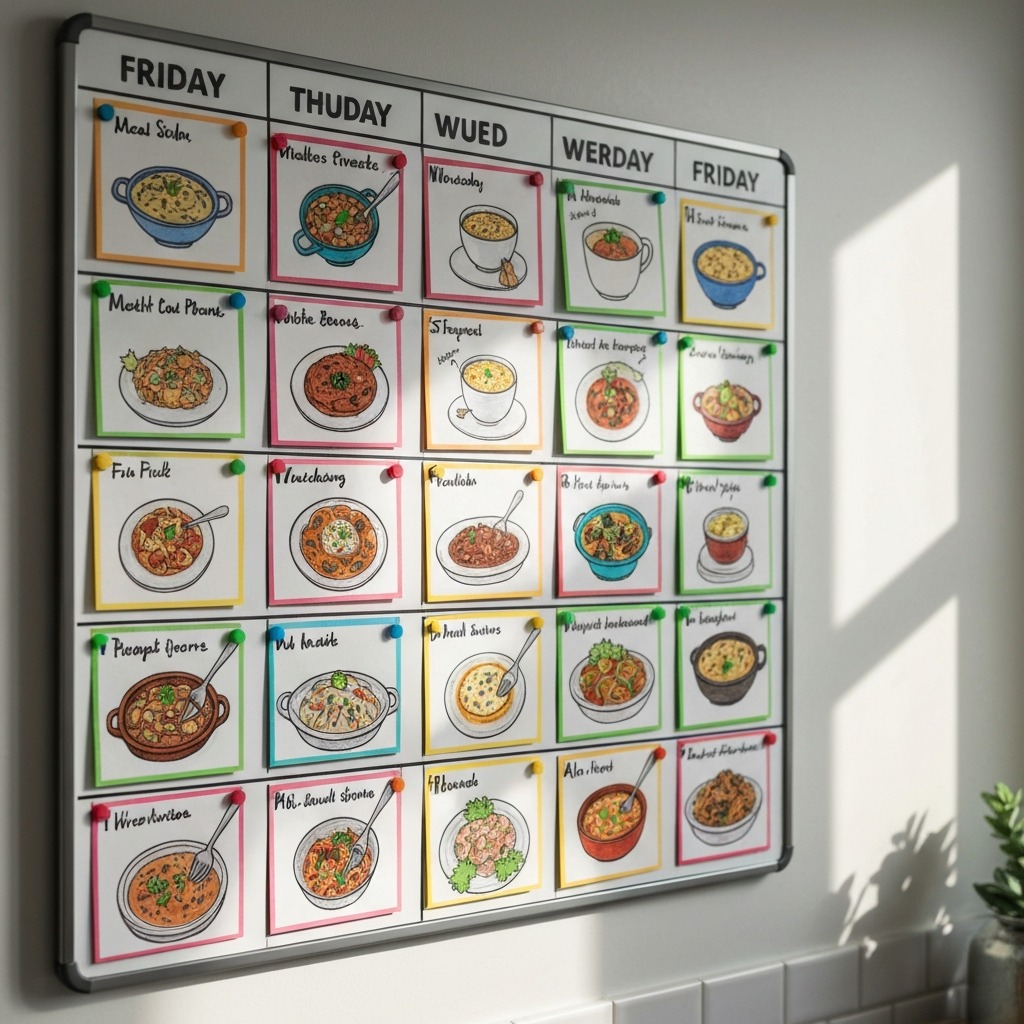 A visible, tangible meal planning system makes the weekly routine clear and engaging for everyone.
The Simple Weekly Ritual
- Same time each week — Sunday morning, Saturday after lunch, whatever works consistently for your family
- Check the fridge and pantry first — what needs to be used up?
- Each child contributes 1–2 meal picks — from an approved list or within parameters you set
- Parents fill remaining slots — ensuring nutritional balance and variety across the week
- Write it where everyone sees it — the fridge whiteboard, a family app, a corkboard in the kitchen
Creating a Meal Card System
For families with younger children, a physical card system works better than any app:
- Create 30–40 meal cards with the family's regular rotation (index cards or printed cards)
- Add pictures for younger children — a photo of the actual dish or a simple illustration
- Colour-code by category — green for vegetable-heavy, blue for fish, red for pasta, etc.
- Let kids pick from the deck — the physical act of choosing and placing a card builds ownership
- Rotate in 2–3 new cards monthly — this is how you gradually expand the family's repertoire
This system works because it feels like a game while maintaining the nutritional guardrails you need. Check out the best meal planning apps for families if you prefer a digital approach.
Making Meal Planning Stick
The families who succeed with this system share three habits:
- They protect the planning time. It's 15 minutes on Sunday and it doesn't get skipped for other activities.
- They honour the choices. If the child planned Wednesday's tacos, Wednesday is tacos. Overriding the choice destroys trust in the system.
- They adapt the system, not the child. If the meal board isn't working, change the format — don't blame the child for not engaging.
Teaching Kids Life Skills Through Food
Meal planning involvement teaches far more than cooking. It builds a cluster of life skills that serve children well into adulthood.
Skills Developed Through Meal Planning
Decision-making. Choosing between options, weighing preferences against constraints, and living with the consequences of choices — all practiced weekly in a low-stakes environment.
Financial literacy. Understanding that food costs money, that choices have budget implications, and that planning reduces waste. Children who participate in meal budgeting develop practical money sense.
Time management. Learning that a meal planned for Tuesday needs ingredients bought on Sunday. Understanding that a roast takes two hours but a stir-fry takes twenty minutes. These are genuine planning skills.
Nutrition awareness. Not through lectures, but through repeated exposure to the concept that meals have components and that balance matters. A child who has placed meal cards into "protein," "vegetable," and "grain" categories for years internalizes balance without it ever being a lesson.
Collaboration. Working with family members who have different preferences, negotiating, and compromising — "I'll agree to your fish if you agree to my pasta" — is social skill development in action.
For families who homeschool or teach practical life skills at home, meal planning is one of the most natural and impactful curricula available.
Common Mistakes to Avoid
1. Asking Open-Ended Questions
"What do you want for dinner?" Answer: "I don't know" or "pizza every night." Always offer structured options within boundaries.
2. Overriding Choices After They're Made
If your child planned Tuesday's pasta bake, make Tuesday's pasta bake. Undermining the choice once destroys trust in the system for months.
3. Inconsistency
A planning ritual that happens "sometimes" doesn't build habits or ownership. Weekly consistency is what produces results — even if it's just 10 minutes.
4. Expecting Immediate Results with Picky Eaters
Improvement in dietary variety from involvement is real but gradual. Plan for 3–6 months of consistent involvement before seeing meaningful change.
5. Turning It Into a Lecture
If every planning session becomes a nutrition lesson, children disengage. Keep it conversational and collaborative. The teaching happens implicitly through the process itself.
6. Age-Inappropriate Expectations
A four-year-old can't plan a balanced week. A twelve-year-old doesn't need you to pick which apple they carry. Match the task to the child's actual capability, not your aspiration.
Frequently Asked Questions
At what age can kids start helping with meal planning? Children can participate from age 2–3 in simple ways: choosing between two meal options, selecting a fruit at the store, or washing vegetables. The complexity of involvement increases naturally with age and capability. By age 9–10, children can genuinely co-plan a week's meals.
Does involving kids in meal planning actually reduce picky eating? Yes — research consistently supports this connection. Children who participate in choosing and preparing food are significantly more willing to try it. Studies show kids try 2–3 times more food types when they helped select or prepare them. However, results take 3–6 months of consistent involvement.
How do I involve kids without losing control of the family's nutrition? Use structured choice: offer a curated selection of options rather than open-ended questions. You control the nutritional parameters and approved options; the child controls which specific meals they prefer within those boundaries. This gives genuine agency while maintaining dietary standards.
What are safe kitchen tasks for young children? Ages 2–4: washing vegetables, tearing lettuce, stirring cold mixtures, mashing with a fork. Ages 4–6: measuring dry ingredients, peeling bananas, spreading with a butter knife, kneading dough. Ages 6–9: peeling vegetables with a Y-peeler, cracking eggs, grating cheese, reading simple recipes. Ages 9–12: supervised knife skills, following recipes independently, making complete simple meals.
What if my child only wants to choose unhealthy foods? Frame choices to steer toward balance: offer a choice of which vegetable (not whether to have one), allow a favourite treat alongside the meal rather than as the meal, and introduce the concept that meals have components — a protein, a vegetable, a carb — and they can choose within each category.
How much time does family meal planning actually take? The weekly planning ritual takes 10–15 minutes. This is an investment that saves time during the week by eliminating daily "what's for dinner?" decisions, reducing grocery trips, and minimizing food waste. Most families find it saves 2–3 hours weekly once the system is established.
What's the best way to start if we've never done meal planning as a family? Start small: pick one meal per week where the child chooses from three parent-approved options. Do this consistently for a month. Then expand to two choices per week, add a physical meal board, and gradually increase involvement. Trying to implement a full system overnight usually fails.
About the Author
Sophie R. is a family nutritionist with over 12 years of experience helping families build sustainable, healthy eating habits. She specializes in child nutrition, picky eating intervention, and practical meal planning systems for busy households. Sophie works with families across the US and UK and contributes regularly to publications on family health and childhood nutrition.
Sources
-
Chu, Y.L., Farmer, A., Fung, C., Kuhle, S., Storey, K.E., & Veugelers, P.J. (2013). "Involvement in home meal preparation is associated with food preference and self-efficacy among Canadian children." Public Health Nutrition, 16(1), 108-112.
-
van der Horst, K., Ferrage, A., & Rytz, A. (2014). "Involving children in meal preparation: Effects on food intake." Appetite, 79, 18-24.
-
Sweetman, C., McGowan, L., Croker, H., & Cooke, L. (2011). "Characteristics of family mealtimes affecting children's vegetable consumption and liking." Journal of the American Dietetic Association, 111(2), 269-273.
-
Fulkerson, J.A., Kubik, M.Y., Rydell, S., et al. (2011). "Focus groups with working parents of school-aged children: what's needed to improve family meals?" Journal of Nutrition Education and Behavior, 43(3), 189-193.
-
Derscheid, L.E., Umoren, J., Kim, S.Y., Henry, B.W., & Zittel, L.L. (2010). "Early childhood teachers' and staff members' perceptions of nutrition and physical activity practices for preschoolers." Journal of Research in Childhood Education, 24(3), 248-265.
-
Walton, K., Horton, N.J., Rifas-Shiman, S.L., et al. (2019). "Exploring the role of family functioning in the association between frequency of family dinners and dietary intake among adolescents and young adults." JAMA Network Open, 2(7), e196852.
Last updated: March 2026
Looking for more family meal planning strategies? Explore our complete guide to meal planning your week in 30 minutes or browse the best meal planning apps for families in 2026.
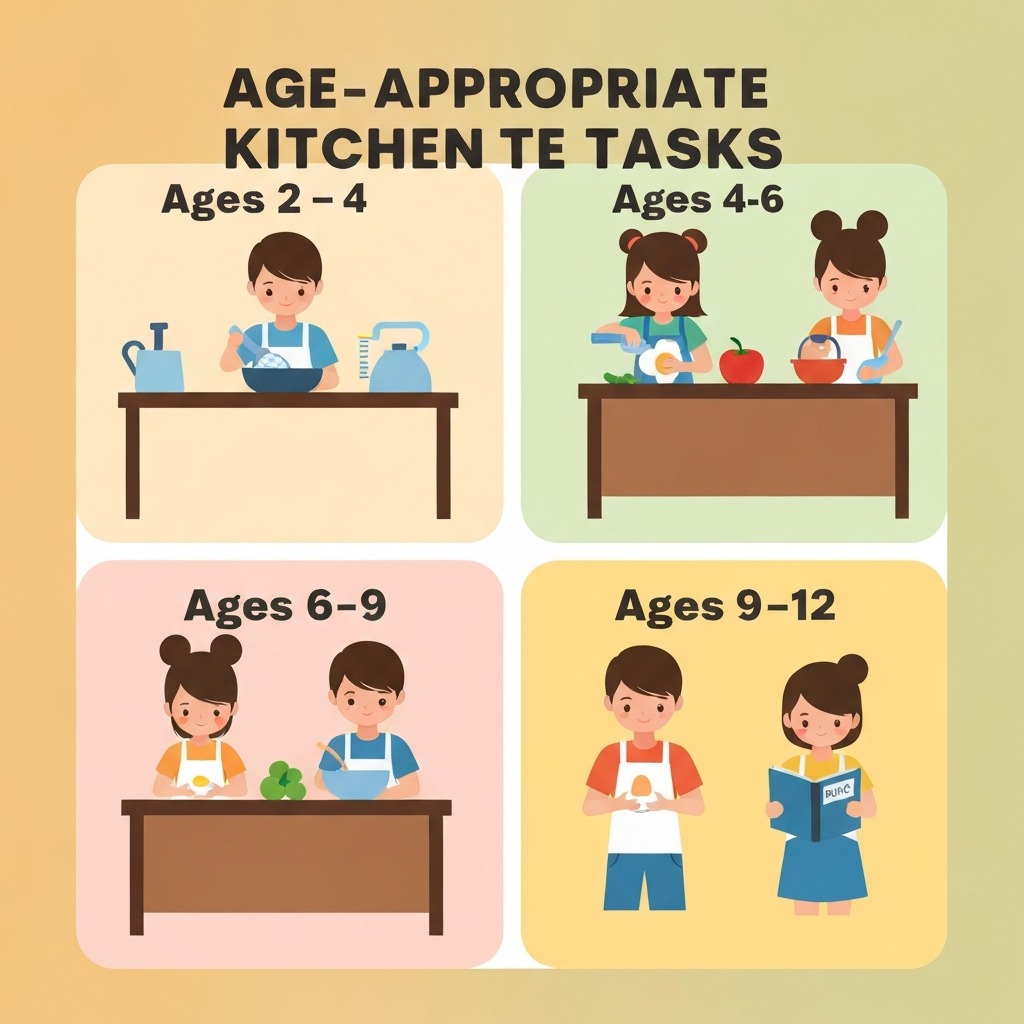 A visual guide to safe and engaging kitchen tasks for every age group.